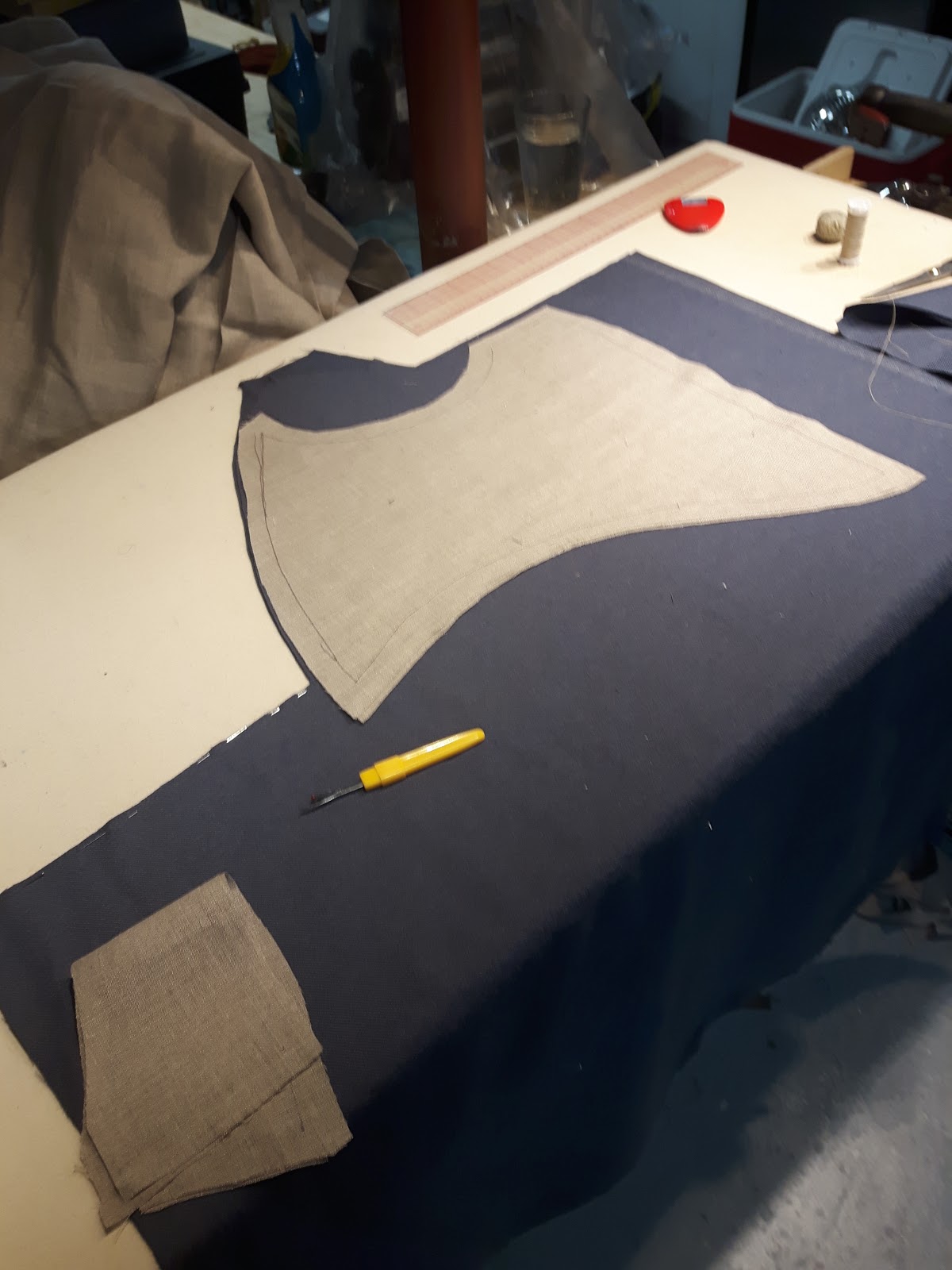
Pierre's new uniform continues apace, buttons arrived yesterday, and the pieces I've been making are all in their final stages. I should be finished by Friday at the latest, which gives me a week to plan food and start my pre-cook.
The thing that the SCA taught me well, is that I love being busy at events. There is nothing worse than sitting around, twiddling one's thumbs in an era where every part of daily life meant work. Being able to have a proper job to do at an event makes me insanely happy. Making food for people is like the highest form of fun, yup, even more enjoyable than sewing.
For the past week, I have been toying with menu items I can cook for the officers next weekend. Lent begins a week from today, so this is likely to be the only meat free event I cook all summer. We are also portraying the French Canadien peoples, so Lent and Catholic dietary restrictions should be a thing. Why not have fun with it!
Saturday morning's breakfast will consist of coffee, chocolate, bread, butter, fruit preserves, and a vegetarian oatmeal (white) pudding.
Lunch: Cod Saint-Menehould, a fish casserole that forms the basis for our modern Quebec fish pie; Talmouse, cheese tarts in the shape of little cocked hats, served with a fruit cheese; Roasted whole garlic, pickled vegetables; and for dessert, a Savoie cake with dessert cream.
Supper will be Feves au lard (baked beans), pea soup, bread and any leftovers from lunch.
Apart from the tarts and cake, I'm planning to make everything on-site. This requires planning out all the ingredients, and preparing the proper historical packaging for them, but also making sure that you have brought all the cooking implements and serving gear you might need. In a perfect world, you could walk into a properly stocked kitchen with your grocery items and just cook, but those perfect kitchens don't exist outside our own homes. I will spend most of next week planning out each dish, what groceries I will need, what cooking implements, and which service pieces I want to use. Yes, it will likely take most of the week to pack. We will pack the car Thursday evening, and leave from the base on Friday after work, hopefully saving about an hour of travel time.
Then, once we get to the fort, unpack the car and set up our kitchen for Saturday, socialize, prep the coffee for the morning, stock firewood next to the hearth if need be...and hope I don't forget anything. From the second we land, until we get back into the car on Saturday evening, we will both be working our arses off and having the time of our lives.
I just hope it's warmer than -28C next weekend, please?!
Bibliography
Dunton, Hope. From the Hearth: Recipes from the World of 18th-Century Louisbourg. University College of Cape Breton Press, 1986.
Vechambre, Chantal, and Anne Marie Lane Jonah. French Taste in Atlantic Canada, 1604-1758: A Gastronomic History. Cape Breton University Press, 2012.
Wednesday, 27 February 2019
Monday, 4 February 2019
an exercise in compromise, uniforming a warm man
The above sketch is from 1780, British Army Recruits. It's a bit later for what we are trying to do for this summer, and British rather than French, but it's a great example of different types of men in the eighteenth century, from proper soldier to regular joe.
Outfitting Pierre as a regular joe has been easy. Over the years I have made him nice clothes, but they tend to stay in the closet, he prefers clothing he can actually work in, and get dirty. So it's been a compromise in attire. I keep him covered in a manner fitting an eighteenth-century man, and yet also make him clothes that he will feel comfortable in. We both have had to shift our modern desires to better suit the situation at hand. He shifted expectations of comfort, I shifted expectations of cleanliness. It has worked for the most part.
This year is different. For the first time, I am making him a uniform that will see a good deal of dirt, grime, and wear. It is still a uniform though, and so there are expectations that need to be met. Compromises will need to be made. First off, Pierre will be wearing a uniform on the weekends as well as Monday to Friday. So his comfort level will be tweaked a bit more.
Let me start with a bit of a modern comparison. When he is issued his modern uniform, he is issued EVERYTHING UNDER THE SUN! He is a Sailor, and so has standard dress uniforms and work dress (Naval combats) for being a Sailor. He is now stationed at a base where the predominate service is the Army, and so he now also has everything an Army soldier could possibly need, including combat gear he would need if he was going to Afghanistan, because there are days where he needs to wear those things, like to the range. We have several kit bags down in basement storage of things he will likely never wear, but he's been issued them, and so we store them.
Now, let's look at this same scenario, but through the historical lens. I need to outfit Pierre as a French soldier this summer. We are portraying a certain unit that was stationed on the frontier of Canada. In the period, he would have been issued with the gear required to survive this field posting. The great thing about the French is that they were fantabulous record keepers, so we have a wealth of information of what was sent and issued to the men. We also have great sketches of the period showing soldiers of the period dressed in that kit.
But what would the average soldier actually wear on a day to day basis?
Pierre is one of those typical French Canadian guys who loves the winter. He is literally never cold...well unless he's coming down with something. He wears a flannel shirt as a winter coat. As soon as it's above freezing, he is back to his spring wind breaker. I bought him a whole winter snow/weather system one year for Christmas, and it may get worn for part of one day, once or twice a year, when he is snow-blowing the entire neighbourhood in a blizzard. Most of the time, flannel shirt over his T shirt. If the temps drop to stupid cold, he might layer a sweatshirt under the flannel.
This weekend we went down to Ticonderoga to get started on his kit for the season. Stuart and Nick tried their darndest to offer more pieces to complete the uniform. They want him properly turned out, warm when he needs to be, properly dressed for a soldier. I felt like that newbie, eighteenth-century reenactor though, knowing that all these uniform pieces wouldn't likely get worn. Pierre would just be too warm. I think we have struck a bit of a compromise, the four of us. I will make Pierre the bare minimum of kit to portray a proper soldier. Pierre will do his best to stay dressed as much as possible. Any extra kit that a soldier would own, could possibly be just pulled from stock at the fort, things that don't fit anyone, or might be too old for wear, to be used as set dressing for the space. Pierre will be working hard labour for most of the day, he will be able to get as dirty as he needs to be. These will be working clothes of an old soldier. I fully expect them to have really good heritage by the end of the first weekend. No fancy parade clothes though. He aims to work. All the chores that soldiers do, but tend to not enjoy, he is most in his element.
So, what is on the docket for the next few weeks? I have breeches and a veste under construction. The veste is a sleeved waistcoat. I also have under-drawers in linen cut, and a fatigue cap kit. There's also another shirt cut for him in my to-do pile. He already owns a capot, shoes, off-white wool stockings, and an apron. For me, I need a new cap; I need to replace the waistband on my old green petticoat; and I will be looking for some blue or green polished cotton to make a new pinner apron. Margaret has my new shoes under construction.
Oh, and I also have two men's suits to finish, under contract, and a thesis proposal paper to wrangle before the Spring.
Our next living history event at Ticonderoga is March 9th. This winter is going to fly!
Monday, 28 January 2019
Picking up where we left off...
Burn's Night weekend is over, tartan was worn, haggis and copious amounts of scotch consumed. Then my dissertation proposal paper returned from my advisor. This past week I have been struggling through the writing process in the mornings, and have treat myself to an hour or so of studio time each day in the afternoons. The gown has taken me all week or so to finish, but now it's done.
I picked up by stitching the pleats into place, and the side back seam on both the fashion layer and the lining.
Then, I took apart the sleeves from mum's bodice. I knew they would be too short for me, and likely were the wrong shape, as I had originally made this gown back in the early 1990s when I didn't know how to make or stitch in an eighteenth-century sleeve. I made a modern one piece sleeve instead. You can see in this photo how very different the modern sleeve is from a historical sleeve.
I picked up by stitching the pleats into place, and the side back seam on both the fashion layer and the lining.
I had originally thought to include the front lining in that side back seam, which would help with some structural support. I quickly realized that the back lining would be a better choice to include with the fashion layer as support, in that it would lay more smoothly in the end with the front lining covering the finished seam. Yes, I still have to use my seam ripper from time to time as I work through the process. The seam was stitched with a running back stitch and strong thread.
This is the inside of the finished fashion layer seam, the front lining pushed out of the way so it wouldn't get accidently caught. I then folded the seam allowance of the lining under, and whip stitched it down the side back seam and along the waist seam until the front waist dart.
This sleeve is from Fitting and Proper, page 9. You can see that the shape of the armscye is different than the one I cut originally. Number one reason why it is always a good idea to have your reference books out on your work bench as you create. This armscye difference is important when you set the sleeve. A modern armscye won't work.
So I ended up piecing the sleeve heavily from the scraps left over from the old bodice of the gown. The two sleeves are even pieced differently from each other, as the scraps I was working with were quite small at this point. I rebuilt the sleeves and then re-attached the original cuff. In the end, they are substantially longer, so cover my elbows, and narrower through the upper arm.
They now are matching in length and width and fit me.
Onto setting the sleeve, remember what that armscye looks like (the top edge of the sleeve), look for the point 'A' referenced in Sharon Burnston's pattern. This is the single most important point on the sleeve. No matter left or right, it is the starting point to setting the sleeve. Match this point with the back shoulder seam point, here...
I match that point, then working the underarm first, I match right sides together in a big sandwich of all the layers, lining of sleeve, fashion fabric of sleeve right sides together with fashion fabric of bodice, and bodice lining. Yes there will be raw edges. They will be dealt with later.
Once you have pinned all the way around to the front armscye joint, just before the shoulder strap starts, you can stitch this bit in place using a running back stitch and strong thread. I have gotten to the point where I pin the whole sleeve in, and then stich though. When learning, it might be easier to stitch in steps.
The top of the sleeve then gets eased into the shoulder strap, pushing the fashion layer out of the way and just stitching sleeve head to strap lining. You need the ease on the top of your shoulder to accommodate that bone at the top of your arm, but also the rounding of the top of your arm. If you do not include any ease here, the bodice of your gown will pull off your body. There's no getting around it. SLEEVES NEED EASE!
I pin the ease in place, and then pleat the excess into one or two pleats at the top back of the sleeve head, just where the sleeve joins the back shoulder seam of the bodice. To sew the top of the shoulder in place, I use a running back stitch, pulling back on the thread to ease in the sleeve head as I sew. You could also run an easing stitch along the sleeve head prior to setting the sleeve, if you need more control.
Once the sleeve is stitched in place, the fashion layer of the shoulder is folded over the top of the sleeve head and stitched down. I then return to the inside of the armscye, and whip stitch the layers together. This gown will never be washed. Most living history garments are rarely laundered, outside shirts, shifts and stockings. If I were making this gown for theatre, I might bias bind the armscye, but it's really overkill and just adds bulk. Trim your seam allowances nicely, and then just whip everything together. The top of the sleeve head will be between the layers of strap, with just the seam allowance of the strap lining showing at this point.
Here is my finished gown, hemmed and everything. I measured the fabric used to be 2metres of 60"wide straight cloth from skirts of mum's gown, the sleeves left over from the gown, and the bodice cut into scraps for piecing. Here are my little piles of what is left over.
This was an exercise in rebuilding a gown from a finite amount of cloth. The rest of the original cloth was re-homed decades ago, so I had to be careful with this gown. The finished gown will be about knee length, and will be worn with a wool petticoat of another cloth, likely also one of mum's old pieces. The remaining scraps of wool cloth are now in the trash, the linen from the lining will be used to make char cloth for fire starting. And I have another new piece of clothing from the mid century period that I will wear for years to come. I am also working through proper construction notes to be included in my dissertation so that other folk can build historically correct gowns in the future, and you won't make the same mistakes I did back in the early 1990s.
Next up, Men's suits!
Wednesday, 16 January 2019
what I do when there's a lack of extant evidence in a particular small period of costume history: new sacque construction.
I am not alone, researchers have found a distinct lack of extant garments from the 'French Canadian' period of the eighteenth-century. First of all, I have always had an issue with calling it the 'French Period', that term always made me think that the French were only here for a certain period of time, then after the French and Indian war, just disappeared. The French are still here in North America, and if you live in Quebec for any length of time, you also realize that some are still fighting that war...but I digress.
The French were here, and still are here, and have been here for a very long time.
Ok, so what are we looking at when we look for French Canadien dress from the mid-eighteenth century? There's not a lot of evidence in portraiture or extant garments, but the French in Canada were amazing records keepers. So there's a lot of written documentation of trade, wills, probate, contracts, all kinds of things. We also know the class level of most people in the French colonies. Armed with this information, and looking at art from France and North America in the surrounding decades, I can put together an idea of what my impersonation should look like.
And there will not be a French bodice, unkempt hair under a mob-ish cap, and exposed shift sleeves anywhere!
You see, I will be portraying a lower sorts woman. Probably from farm stock, hardworking, not a lot of money for personal material culture. I might be poor, but I am not trash. There's the thing, as I sit here, listening to the old-timers tell tourists that followers of the army were all prostitutes. I might be poor, but I'm not a fallen woman in need of clothing! (cue mental images of all kinds that I will never portray)
Look at this lovely painting by Chardin (1699-1779) of a kitchen maid. Now, this painting was done in France, of a French woman, and is from the first half of the century instead of mid century, but she is fully dressed! A kitchen maid! Then, if you look at the image I posted yesterday or the French Canadien couple from the first quarter of the nineteenth-century and see that they are also both fully dressed, you might get an idea of how very wrong going about in shift sleeves and slovenly looking is to my eye. Clothing is such an important marker of class and culture, just look at how scandalous the bikini was when it first came out! The designer had to hire prostitutes to model it, American women who wore it to the beach were arrested for indecency in the early days of it's existence. I have to think that decency played a role in how people dressed in the eighteenth-century as well, and if everyone around you, in the decades before and after the 'French Period', and the cultures around the French colonies, are fully dressed, maybe the French Canadiens were fully dressed too.
Ok, so there's my reasoning behind what I am up to with my new clothes. This painting by Chardin is actually the look I am after with my new clothes. The gown rebuild means there's not enough cloth for a full length gown, and Chardin depicts many women with this shorter length of gown. I also am not entirely convinced that what we are looking at is an unstructured manteau, but an actual gown. Check out those sleeves. That is a big marker in my books. Now, I may, or may not wear stays underneath my clothes, I haven't decided. I may go for a slightly less structured waistcoat, but it will be worn as underwear, not my outer garments. For now, I am building the gown to be worn over stays.
Ok, so construction photos...
This is the other panel of skirt from mum's old gown. I cut it lengthwise so that I would have two front panels, roughly 45" wide (I just cut it, I haven't actually measured, so roughly). The gown's skirts are shorter, because mum was shorter than me, so I knew I would have to do some piecing. I also want to do a 'grown on' robing, not a separate piece, as I am making a sacque from an earlier decade, and there were still elements left over from a fully draped garment such as the Mantua.
So, I added the shoulder strap to the bodice lining, and a big chunk of wool pieced to the top of that front panel so I could fold back the robing.
Next, I carefully folded and pressed the robings in place. Because there is a slight curve to the shoulder strap, I made sure I also curved the robings with the steam iron. Yes, there is a slight chunk missing from the top of the shoulder strap, it's above the seam line though, so I will have no problem stitching the wool in place and not having a chunk missing from the shoulder of the finished garment. I cut the excess off the end of the robing later, just before I stitched it to the back shoulder.
Then, I folded the robing back, so that my seam allowance was underneath, and then basted the robing along that V fold. You can see my little blue stitches in the second photo.
Quick note, I finish the edges of my linings before stitching them in place, so turning up the bottom edge, pressing all my seam allowances properly, all that stuff. It really does make a difference to the overall finished product. The steam iron is your most important tool in the shop, use it. Ok, these photos show the lining pinned in place along that basting line, and then stitched down along the front edge. My stitching goes through to the right side of the bodice along that basting line for the robing. You won't see it when I am wearing the garment though, because it's under the robing, but the extra line of stitching gives support to that front edge. It's firmly nailed down.
The finished front edge.
Just before I finished for the day I stitched the back shoulder seam, and side seams. I then slashed into the waistline and put it on the dolly to drape the side pleats and see how things were progressing.
This is where she will sit for a few days. I now have to switch gears and prepare for a weekend of Burn's Night activities at the Mess. Yes, we will be there both evenings, so I need to dig out all my tartan clothes and get them ready for wearing. There will be alterations, since I haven't had them on in well over 15 years...
It's a good thing I know how to sew!
Tuesday, 15 January 2019
Stepping back in time this year.
If we are going to play with Ticonderoga this year, we will have to step back in time a bit, as the site will be working on interpretation of the French and Indian war period. We will also shift our culture slightly, from my family's history to Pierre's, as we go from being loyalists to portraying a French soldier and his wife. Kit that we wear for Revolutionary period events just won't be appropriate, given that it is almost 25 years later, and a different culture. So this winter, I am building some new pieces of kit, pulling out old kit that we used to wear to Louisbourg, and seeing what pieces are needed to fill out our interpretation.
Truth be told, I have not been impressed with the clothing worn by many people portraying French Canadiens or Acadiens in Canada. I have grown weary of unbuttoned waistcoats, shift and shirt sleeves exposed, sloppy stockings, and messy, unkempt, and uncovered hair. I refuse to believe that Pierre's ancestors were as slovenly as modern day interpreters make them out to be, especially given how 'fashionable' modern French Canadians tend to be! The above image may be late in the 18th-century, but it shows impeccably groomed people, even if they are also the typical farming class that is widespread in French speaking Canada. The modern interpreter looks nothing like this! I won't post a photo, because I don't want to embarrass anyone personally, just do a quick google search and you will understand, if you haven't already had first hand experience. Let's just say, I am going back to basics and doing my own research. Fort Ticonderoga requires a fair degree of accuracy in kit, so I know my research won't be wasted time.
Pierre's kit will be fairly straight forward, build 'this' particular uniform, and be the same as all the other soldiers at the fort. I have to purchase the materials to make the uniform from specific retailers and build it according to extensive guidelines laid out by the fort. For me, an easy task, since I really do enjoy extensive guidelines and understanding what is expected. Even better in my books would be the ability of purchasing a kit to make the uniform, so that I know I have exactly the same fabrics as the other soldiers. Fingers crossed that this is an option.
In the meantime, I am working on some new pieces for myself. I hauled out my 'old brown sacque' from storage, and am still happy with it. Being a linsey, it will be great for summertime wear. It's now gotten some really great heritage too, since it was my only gown for a good number of years. To round out that outfit, I will make a couple of new caps, possibly a new pinner apron (I'd love one in blue), and I have to re-thread my cross on a length of black silk ribbon. For winter or shoulder season though, I need some warm clothes. Since it is always cold in Louisbourg, this will not be a waste of my time, as these pieces will get wear in the future too. I am taking this opportunity to rebuild a gown of my mum's into something that will fit me. Taking it apart, and re-cutting pieces to build into something appropriate for me and the historical period I am wanting to recreate.
Yesterday, I pulled out my gown pattern, a paper pattern traced from a bodice draping my friend Jenny did for me back in September. A bodice is a fairly straight forward pattern throughout the eighteenth-century. With minor alterations, it can take you from an early sacque, to a late period round gown.
I started with the back lining sections. Instead of seaming the centre back seam straight down to the waist, I added on a facing which was turned back into a double fold from the shoulder blade line downwards. This was hemmed in place with a slip stitch. I also boned each side of the opening with 1/4" nylon zip strap boning backstitched into place. Then I worked the eyelets that will tighten the sacque bodice to my body. Once this was finished, I laid the back lining wrong side up on my work table, and pleated the fashion fabric to the bodice.
I followed an extant gown pattern from a reputable published book (you know the drill, Sharon Burnston, Linda Baumgarten, Janet Arnold are all reputable resources). I had to alter the pleating pattern slightly to accommodate the amount of fabric I have, I am rebuilding one of mum's gowns after all...that fabric is close to 30 years old...it's all I have. I made sure that my pleats were even and square with the bodice lining, and marked how far down I wanted them stitched. Then, with a running back stitch, 1/8" in from the edge of the fold, I stitched the pleats to the bodice lining. I do this flat on my work table so that the weight of the cloth is supported...that, and for a long period of time, I did not have a dress dolly, and I suspect many sempsters also lack a dress form, so I also teach this way.
The single thing that many people miss when making a sacque is the line of basting that runs underneath the pleats to hold the fabric to the lining all the way down to the waist. If you miss this important line of stitching, you will look like you are wearing a sack instead of a sacque, the bodice will not hug your body, and the pleats will not spring forth from the shoulders. To do this, once the tops of the pleats were stitched, I moved the bottom of the pleats to the side, and ran a running back stitch following the line of pins.
Voila! The finished back panel, pleats stitched down, excess cut away (but saved for later piecing), and a good steam press to the top of the pleats. Today, I will tackle the fronts of the bodice. Friday, 14 December 2018
Logistics
![]() |
| view of Halifax, Dominic Serres, 1765, Art Gallery of Nova Scotia |
And it's much easier now that there is just two of us working in this machine.
We used to joke that by adding one person to a living history event, we ended up packing twice as much kit. And this was true. Not just kit, but also emotional kit. We were so used to working as a team, that together we act like one person, but add another person to that mix, we needed to consider that person. No matter how close they were to us, they were still a separate person. With their own needs, desires, expectations.
Now think of adding a couple hundred people to your mix. This is what running a living history event is like. You can't simply go about your day, situation normal. You can't get up with your own schedule, pour your own coffee, and go do your job for the day. You have to take into consideration all the people who are coming out for your event.
It's really important for the people attending your event to know the history behind the scenario you are trying to interpret for the day, but it is also important for people to understand the logistics. This really hit home a couple of times this year when attending events for the first time, in places I had never been before, with people I had never met. Because the majority of the event attendees had done these events multiple times before, they knew what to expect. I didn't even know what kinds of questions to ask, since there was so much I didn't know, I didn't know where to start to ask.
When we moved here to Montreal. I knew a few things about military moves. Now that I have done one, I know more, so the next time should run a bit more smoothly...one can hope. The same applies to living history events. With the move, there are logistics that I will expect and ask for. Timelines I will know to also expect. We should be asking ourselves these types of questions about the living history events we plan as well...especially when we know the event better than anyone else.
For future living history events, I would like to see a brief synapsis of the event itself. I don't really need to be writing a 30 page academic paper on it, so a brief overview of the history is really all I need. I need to know what event staff want from me. Am I Loyalist? Patriot? Undecided? Who am I working for? What jobs do I need to be doing during the interpretation? What material culture do I need to bring with me? Am I expected to be doing full-on interpretation? Or am I also expected to do security and crowd control? Will I be indoors, or outside most of the day? Walking long distances? I wear high heels most of the time, so this is important. What time am I expected to be on site, ready for business, and when am I expecting to be able to leave and go home? If everyone knows what they are supposed to be doing before they arrive on-site, then the interpretation runs much more smoothly overall, and there's less frantic, last minute rushing around, trying to make things work.
There are other things that are important to know. Is this event just a single day, or is it only part of a day? We went to an event this year, driving five hours, to find out that the interpretation was only an hour. We were lost for the rest of the weekend, not knowing what to do with ourselves, and to be honest, disappointed. We should be telling our interpreters this. But also, what sort of sleeping accommodation is available, and what sort of meal arrangements are available. We don't always need to be putting on big, catered spreads of food, like Parks Canada has done in the past, but knowing that the site restaurant will be open later or earlier so we can eat is fantastic information. I honestly don't mind paying for my meals, but I need to know where I can get them. I also need to know where the closest hotels are, if I need some sort of modern sleeping accommodation at the last minute (post tropical storm hypothermia, anyone?). Knowing there aren't any hotels nearby, is also helpful.
You may not think that a little tid-bit of information is all that important, but it could be important to someone. Together, let's plan events a bit better. Let's be sharing information a bit more widely. And not expecting because we have always done it this way, that everyone knows what 'that way' is.
Monday, 10 December 2018
the social life of things: a year in the life of an object and a living historian
I have to admit, the type of interpretation programming that really rocks my socks is the year in the life type of interpretation programing. Situations like Tales from the Green Valley or Victorian Farm, where the gang gets together and 'lives' as they would for a full calendar year.
This year I got to come about as close as I currently can to feeling all the seasonal feels. We spent three weekends at Ticonderoga this year, in the Spring, Summer, and Fall. We would have rounded out the winter with another weekend this coming weekend, if it weren't for coming down with strep throat this week. Each of those weekends we worked on similar interpretation, but with a varying climate and happenings of history going on. For this weekend, I was working through Christmas season thoughts on what they would have had during the Christmas of 1776. How I could reproduce the creature comforts for officers to eat while having a limited cooking set up, in the frontier of New York state. I was enjoying other historic sites setting up their own Christmas programs and the photos that they were sharing. I may not have been able to produce all the fancy things the finer house museums would have had, but I think I would have been able to make a fine Christmas out of not much. Items like a Christmas stolen and a fine fruit pudding would have made use of dried fruits and could be made in a bake kettle or a soup kettle over the fire. Pies of custard, pork (tortiere), or mince could also be made along a similar fashion. My planned menu was all of items that I could have made in the few days prior to Christmas day, and kept with very little problem.
I was also thinking of our clothing, what we would wear, what we would need. What would we look like, two servants to the officers, within their space, but not of it. Pierre was going to wear his black wool suit, nice enough to serve in; black, and would hide any dirt from cooking. I have a serviceable blue wool gown under construction; again, nice enough to serve in, dark enough to disguise any dirt.
Through this year, I have been producing all the clothing items that we would need to live our lives as eighteenth-century people. There's very little left now that I think we would need. The final items are things I will need to buy to round out our impressions of working class people. Shoes are next on the list, as I really miss being on heels when we've been in the eighteenth-century, my work shoes are flats and quite honestly, fugly. I live in heels in my modern life. Women in the era lived in high heels too. The extant women's shoes are predominantly heeled, not flats.
The other items are for serving, so platters, another big cooking kettle, and I'm still on the hunt for a couple of table spoons.
Someday, I might get to actually run a year of interpretation programming somewhere, or maybe multiple years... Then I can truly get my nerd on and study the wear patterns of our clothing more fully, and get further into character than I have ever had the chance to before.
Until then, I will live vicariously through social media and photographs, and maybe make a syllabub and some custard tarts for Pierre and I to indulge in this weekend, while we sit home and recover from the dreaded pox of the throat.
![]() |
| waiting to serve, Saturday July 21st 2018, Ticonderoga |
Subscribe to:
Posts (Atom)